
Click here to Download our free peptide guide

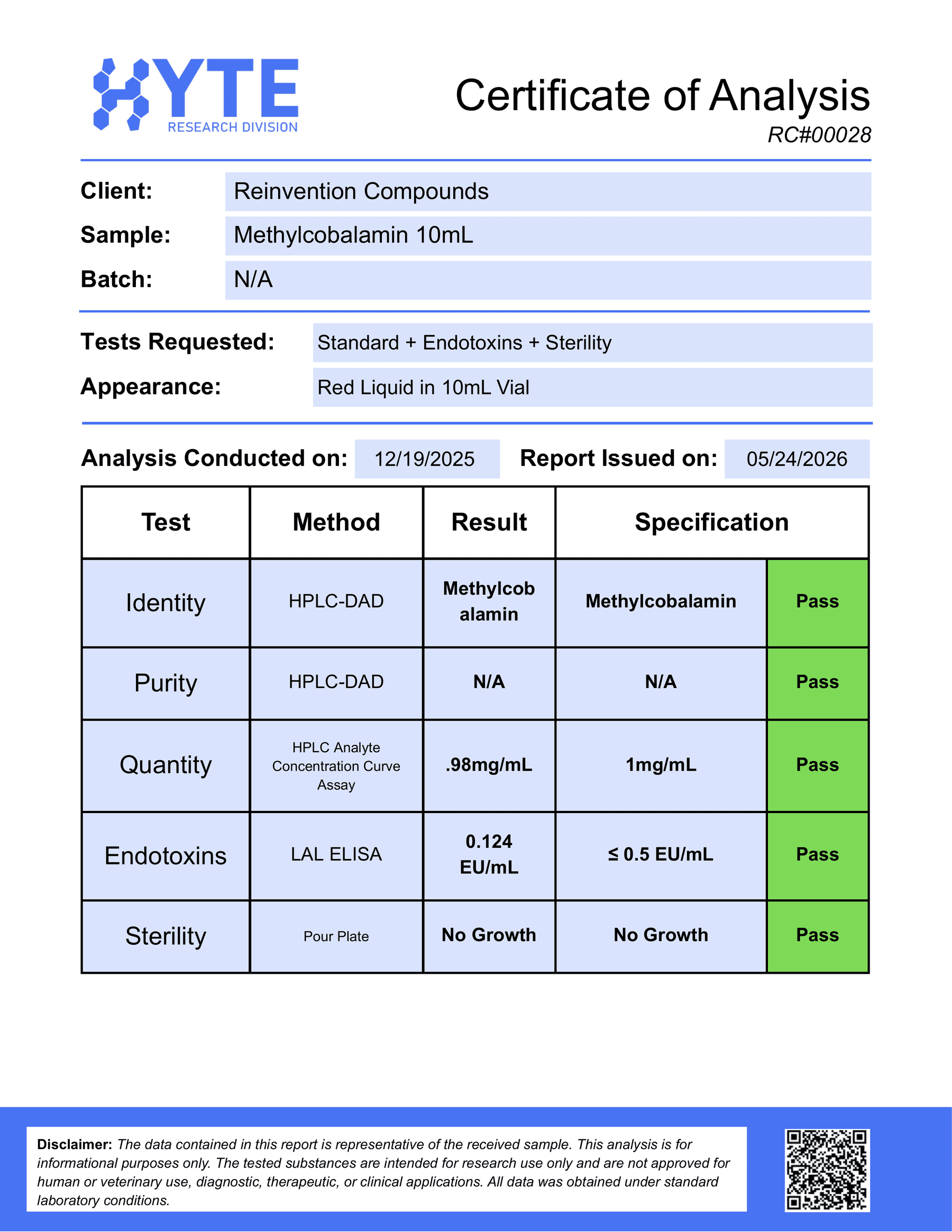
Methylcobalamin (B12) Solution – 10ml

Please note, all orders are processed Monday – Friday 8:00 a.m. – 4:00 p.m. est. Any orders received after 4:00 p.m. est will be processed during the next business day.

Loading...

Methylcobalamin (B12) Solution – 10ml

$44.99

Methylcobalamin (B12) 0.9% Benzyl Alcohol Description

Methylcobalamin (mecobalamin, MeCbl) is one of the two naturally active coenzyme forms of vitamin B12, differing from synthetic cyanocobalamin in that a methyl group replaces the cyano group on the central cobalt atom. This is the form of B12 the body uses directly in the methylation cycle.

Methylcobalamin functions primarily as the essential cofactor for methionine synthase, the enzyme that remethylates homocysteine into methionine — a step central to homocysteine regulation and to producing SAMe, the body’s universal methyl donor. It is noted in the literature for a relatively stronger affinity for nervous tissue than other cobalamin forms.

Because of its role in homocysteine metabolism, myelin maintenance, and methylation-dependent processes, methylcobalamin has been extensively studied in research contexts including peripheral nerve regeneration, remyelination, and neuroprotective signaling. This product is being sold for its use in research only.

SKU: B12_10 Category:

You may also like

Glutathione – 1500mg

$74.99

Nicotinamide Adenine Dinucleotide (NAD+) – 500mg

$64.99

Research Bacteriostatic Water

Price range: $9.99 through $24.99

GLP-1-SM – 20mg

$149.99

GLP-2-TR

Price range: $139.99 through $159.99

Methylcobalamin (B12) 0.9% Benzyl Alcohol Description

Methylcobalamin (mecobalamin, MeCbl) is one of the two naturally active coenzyme forms of vitamin B12 (cobalamin), alongside adenosylcobalamin. Structurally, it is an octahedral cobalt-centered corrin complex that differs from synthetic cyanocobalamin in that the cyano group bound to the central cobalt atom is replaced by a methyl group. This methyl group is biologically significant, as it is the form of B12 that the body uses directly in the cytosolic methylation cycle without requiring conversion.

Methylcobalamin functions primarily as the essential cofactor for methionine synthase (5-methyltetrahydrofolate-homocysteine methyltransferase), the enzyme that catalyzes the remethylation of homocysteine to methionine. This reaction sits at the convergence of the folate cycle and the methylation cycle, regenerating tetrahydrofolate and producing methionine — the precursor to S-adenosylmethionine (SAMe), the body’s universal methyl donor for DNA, protein, and lipid methylation reactions.

Because of its central role in homocysteine metabolism, myelin maintenance, and methylation-dependent processes, methylcobalamin has been extensively studied in research contexts ranging from peripheral nerve regeneration and neuroprotection to homocysteine regulation. It is noted in the literature for a relatively stronger affinity for nervous tissue compared to other cobalamin analogs.

Compound Information

Property Value
Molecular Formula C63H91CoN13O14P
Molecular Weight 1344.38 g/mol
CAS Number 13422-55-4
PubChem CID 60196341
Synonyms Mecobalamin, MeCbl, MeB12, Methyl vitamin B12, Cobalamin (methyl form)

Lyophilized Compounds:

This compound is freeze-dried, a process that not only extends shelf life but also preserves the purity and integrity of the compound during storage. We do not use any fillers in this process. Methylcobalamin is light-sensitive and should be protected from light during storage and handling.

Sealed Vial: Lyophilized Powder

CAS No.: 13422-55-4

Other Names: Mecobalamin, Methyl-B12, Vitamin B12 (methylcobalamin form)

This Product is Not For Human Consumption and is for Laboratory Use Only. Please Read our Terms and Conditions.

Disclaimer: For Research Purposes Only This content is provided strictly for research purposes and does not constitute an endorsement or recommendation for the non-laboratory application or improper handling of compounds designed for research. The information, including discussions about specific compounds and their researched benefits, is presented for informational purposes only and must not be construed as health, clinical, or legal guidance, nor an encouragement for non-research use. Compounds described here are solely for use in structured scientific study by authorized individuals. We advise consulting with research experts, medical practitioners, or legal counsel prior to any decisions about obtaining or utilizing these compounds. The expectation of responsible, ethical utilization of this information for legitimate investigative and scholarly objectives is paramount. This notice is dynamic and governs all provided content on research compounds.

Methylcobalamin Research

The following sections explore the applications and mechanisms of Methylcobalamin across multiple research domains. As the active, methylation-cycle form of vitamin B12, methylcobalamin has been investigated for roles extending beyond basic nutritional sufficiency, with particular research interest in its neuroprotective and nerve-regenerative properties.

This overview synthesizes key findings on its cofactor mechanism, role in homocysteine metabolism, and experimental applications in peripheral nerve regeneration, myelination, and neuroprotective signaling.

Cofactor Mechanism and the Methylation Cycle

Methylcobalamin is the specific vitamin B12 form used by methionine synthase. In this role it serves as an intermediate methyl carrier, accepting a methyl group from 5-methyltetrahydrofolate and transferring it to homocysteine to form methionine. This step is essential for regenerating tetrahydrofolate (linking folate and B12 metabolism) and for producing SAMe, which drives the methylation reactions required for normal nervous system function.

A core research focus is methylcobalamin’s role in lowering homocysteine. Elevated homocysteine (hyperhomocysteinemia) is studied as an independent risk marker in vascular and neurological research, and methylcobalamin’s capacity to support its conversion to methionine is central to much of the literature on its mechanism.

Nerve Regeneration and Signaling Pathways

A significant body of preclinical research has examined methylcobalamin’s effects on peripheral nerve repair. A frequently cited study (Okada et al., 2010, Experimental Neurology) demonstrated that methylcobalamin increases the activity of the Erk1/2 and Akt signaling pathways through the methylation cycle and promotes nerve regeneration in a rat sciatic nerve injury model. These pro-survival and pro-regenerative cascades are mechanistically linked to neuronal survival, neurite outgrowth, and nerve conduction.

Additional in vivo work has reported methylcobalamin-associated nerve regeneration across multiple injury and neuropathy models, including streptozotocin-diabetic rats, acrylamide neuropathy models, and end-to-side neurorrhaphy studies in which systemic methylcobalamin enhanced donor-axon sprouting and recipient muscle innervation.

Myelination and Schwann Cell Research

Methylcobalamin has been studied for its role in myelin sheath synthesis and maintenance, which is critical to proper nerve conduction. Research published in Frontiers in Cellular Neuroscience reported that methylcobalamin promoted Schwann cell differentiation and increased myelin basic protein expression in vitro, and promoted remyelination alongside motor and sensory functional recovery in a focal demyelination rat model. Further work in models of ammonia-related neurotoxicity reported restoration of hippocampal myelination correlated with methionine synthase activity and homocysteine normalization.

Peripheral Neuropathy Research

Methylcobalamin has been investigated in clinical research on peripheral neuropathy, often as a component of combination formulations. Trials examining methylcobalamin — frequently combined with L-methylfolate and pyridoxal-5′-phosphate — in diabetic peripheral neuropathy have reported improvements in neuropathic symptom scores and associated reductions in plasma homocysteine, though outcomes on objective measures such as vibration perception threshold have varied across studies. The research literature characterizes methylcobalamin as generally well tolerated in these investigations.

Neuroprotection and Antioxidant Research

Beyond its cofactor role, methylcobalamin has been examined for direct neuroprotective and antioxidant properties, including studies exploring protection of neuronal cells against oxidative-stress-induced damage and its action on downstream mechanisms of nerve growth factor and brain-derived neurotrophic factor (BDNF). These pathways remain areas of ongoing investigation.

{{ reviewsTotal }}{{ options.labels.singularReviewCountLabel }}
{{ reviewsTotal }}{{ options.labels.pluralReviewCountLabel }}
{{ options.labels.newReviewButton }}
{{ userData.canReview.message }}

Related Products

L-Carnitine + Methylcobalamin (B12) – 30ml

$79.99

Nicotinamide Adenine Dinucleotide (NAD+) – 500mg

$64.99

Join Waitlist We will inform you when the product arrives in stock. Please leave your valid email address below.