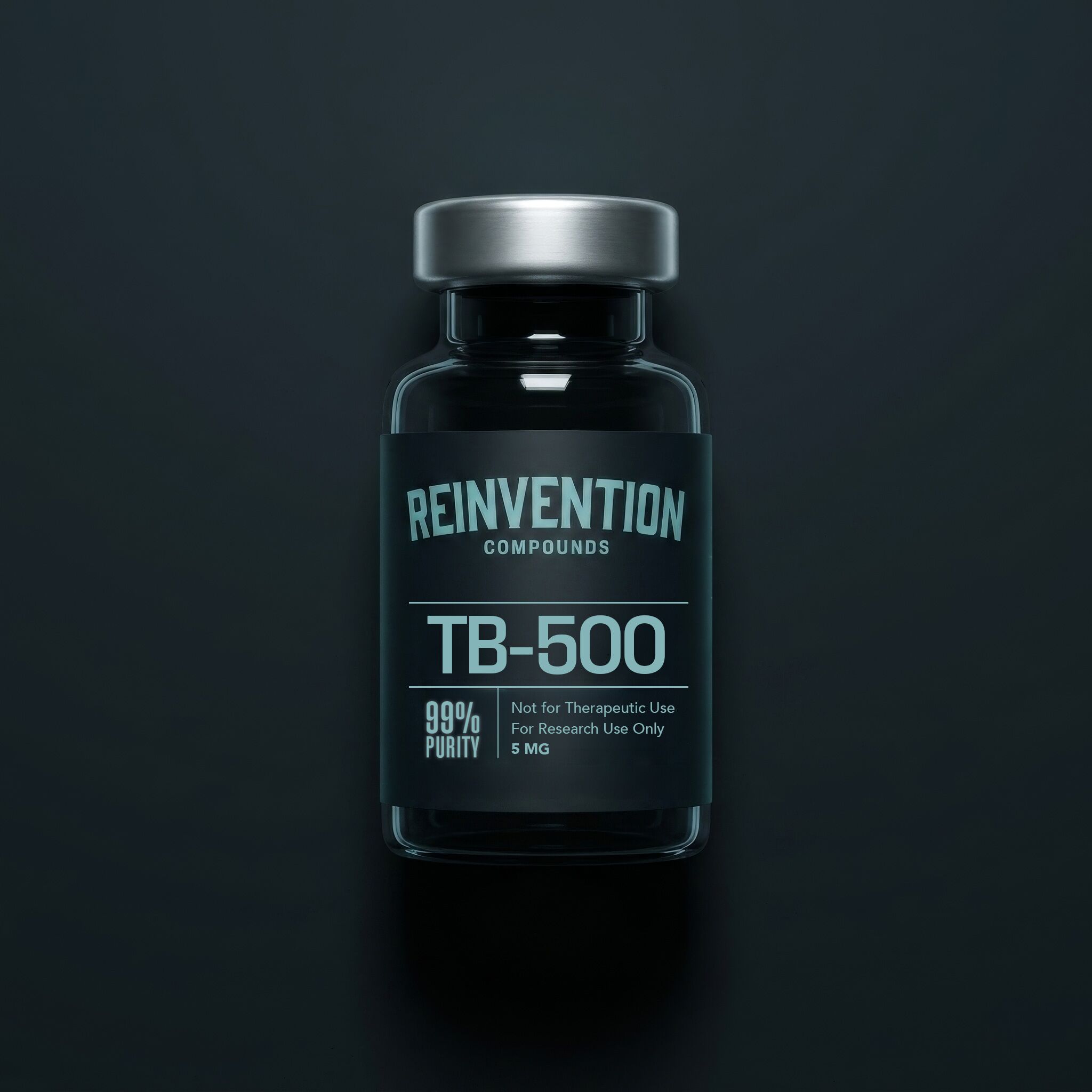
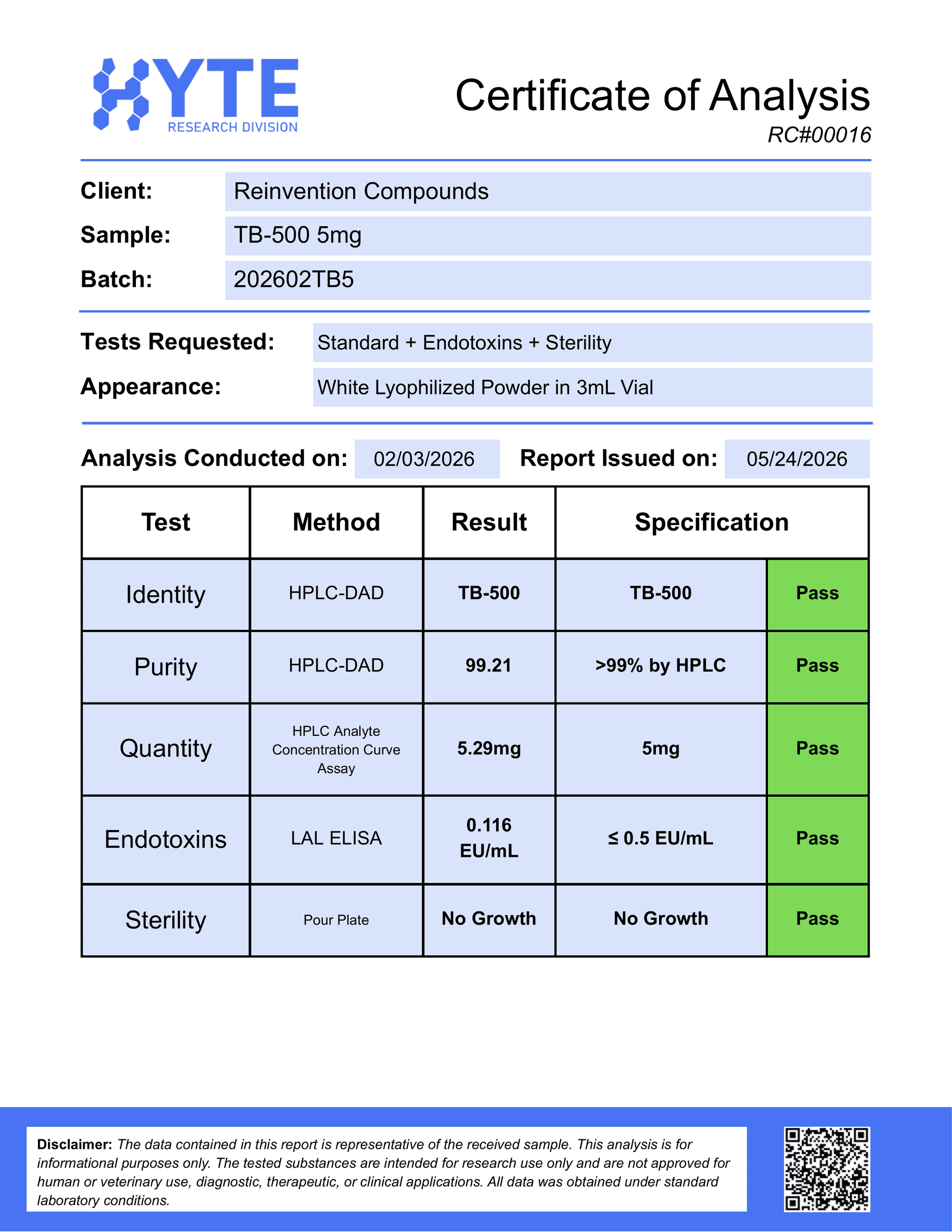
TB-500 5mg Description
TB-500 is a synthetic version of Thymosin Beta-4 (Tβ4), a naturally occurring 43-amino-acid peptide encoded by the TMSB4X gene and present in nearly all mammalian cells — especially in platelets, white blood cells, and tissues undergoing active repair. It is one of the most abundant intracellular peptides in the body and is released at sites of injury to initiate the repair cascade. The synthetic research peptide is supplied with an N-terminal acetylated, 43-residue sequence corresponding to the full Thymosin Beta-4 molecule.
The peptide’s primary molecular function is the sequestration of G-actin (monomeric actin). Within its sequence, a conserved actin-binding motif (the LKKTET region) binds actin monomers and prevents their premature polymerization into filaments, allowing cells to dynamically reorganize their cytoskeleton. This actin-regulating activity underlies TB-500’s broader research profile: promotion of cell migration, angiogenesis, modulation of inflammation, and reduction of fibrosis during tissue remodeling.
TB-500 / Thymosin Beta-4 is one of the most extensively investigated regenerative peptides, with a research record spanning dermal and corneal wound healing, cardiac and CNS injury models, and angiogenesis — including genuine Phase II human clinical trial data across multiple indications. It is studied here strictly as a research peptide.
Peptide Information
| Peptide Sequence | Ac-Ser-Asp-Lys-Pro-Asp-Met-Ala-Glu-Ile-Glu-Lys-Phe-Asp-Lys-Ser-Lys-Leu-Lys-Lys-Thr-Glu-Thr-Gln-Glu-Lys-Asn-Pro-Leu-Pro-Ser-Lys-Glu-Thr-Ile-Glu-Gln-Glu-Lys-Gln-Ala-Gly-Glu-Ser (43 aa, N-terminal acetylated) |
| Molecular Formula | C212H350N56O78S |
| Molecular Weight | 4963.4 g/mol |
| CAS Number | 77591-33-4 |
| PubChem CID | 16132341 |
| Synonyms | Thymosin Beta-4, Tβ4, TB4, Timbetasin, Fequesetide |
| Supplied As | Acetate salt |
Lyophilized Peptides:
These peptides are freeze-dried, a process that not only extends shelf life but also preserves the purity and integrity of the peptides during storage. We do not use any fillers in this process. TB-500 should be stored refrigerated and protected from light.
Sealed Vial: 10mg of Lyophilized Powder in 3ml Vial
CAS No.: 77591-33-4
Other Names: Thymosin Beta-4, Tβ4, TB4, Timbetasin
This Product is Not For Human Consumption and is for Laboratory Use Only. Please Read our Terms and Conditions.
Disclaimer: For Research Purposes Only
This content is provided strictly for research purposes and does not constitute an endorsement or recommendation for the non-laboratory application or improper handling of peptides designed for research. The information, including discussions about specific peptides and their researched benefits, is presented for informational purposes only and must not be construed as health, clinical, or legal guidance, nor an encouragement for non-research use. Peptides described here are solely for use in structured scientific study by authorized individuals. We advise consulting with research experts, medical practitioners, or legal counsel prior to any decisions about obtaining or utilizing these peptides. The expectation of responsible, ethical utilization of this information for legitimate investigative and scholarly objectives is paramount. This notice is dynamic and governs all provided content on research peptides.
TB-500 Research
The following sections explore the diverse applications and mechanisms of TB-500 (Thymosin Beta-4) across multiple research domains. As one of the most abundant intracellular peptides and a major actin-sequestering molecule, it has an extensive preclinical literature and a degree of human clinical-trial validation uncommon among regenerative peptides.
This overview synthesizes key findings on its actin-binding mechanism and experimental applications in tissue repair, angiogenesis, cardiac regeneration, and dermal wound healing.
Actin Sequestration Mechanism
Thymosin Beta-4’s defining role is as the principal G-actin-sequestering peptide in eukaryotic cells. Foundational reviews characterize how Tβ4 binds actin monomers via its conserved actin-binding motif to regulate polymerization dynamics, and how this cytoskeletal control enables the cell migration central to tissue repair — an “actin-sequestering protein that moonlights to repair injured tissues”1. Comprehensive reviews further detail its release by platelets and macrophages at injury sites and its role in reducing apoptosis, inflammation, and fibrosis2.
Tissue Repair and Cell Migration
A large body of research documents Tβ4’s promotion of cell migration and tissue regeneration. Mechanistic studies showed that Tβ4 activates integrin-linked kinase (ILK) and promotes cell migration and survival, linking its actin activity to defined intracellular survival and motility signaling3. Reviews describe its mobilization and differentiation of stem/progenitor cells as a core feature of its regenerative profile2.
Angiogenesis Research
Tβ4 has been extensively studied for its pro-angiogenic activity. Research demonstrated that Thymosin Beta-4 stimulates endothelial cell migration and the formation of new blood vessels, supporting perfusion of healing tissues — a key mechanism connecting its actin-regulating function to vascularized tissue repair4.
Cardiac Regeneration Research
Among the most cited findings is Tβ4’s role in cardiac repair. A landmark study reported that Thymosin Beta-4 activates integrin-linked kinase and Akt, promotes cardiomyocyte and epicardial cell migration and survival, and improves cardiac function in injury models — establishing Tβ4 as a significant target in cardiac regeneration research5.
Dermal Wound Healing Research
The dermal repair literature is mature. Research established that Tβ4 promotes dermal wound healing and accelerates closure of full-thickness wounds across multiple animal models, including diabetic, steroid-treated, and aged models — work that subsequently progressed into preclinical and human dermal-healing studies6.
Research Considerations
In characterized research, Tβ4 is consistently described as well tolerated, with injection-site irritation among the few commonly noted effects and rare reports of histamine-type responses in sensitive models. Because the full-length molecule and its active fragments can engage actin dynamics, study designs typically account for preparation and dosing variables. These considerations are routinely accounted for within controlled study protocols.
References
- Goldstein, A. L., Hannappel, E., & Kleinman, H. K. (2005). Thymosin β4: actin-sequestering protein moonlights to repair injured tissues. Trends in Molecular Medicine, 11(9), 421–429. https://doi.org/10.1016/j.molmed.2005.07.004
- Goldstein, A. L., Hannappel, E., Sosne, G., & Kleinman, H. K. (2012). Thymosin β4: a multi-functional regenerative peptide. Basic properties and clinical applications. Expert Opinion on Biological Therapy, 12(1), 37–51. https://doi.org/10.1517/14712598.2012.634793
- Philp, D., Huff, T., Gho, Y. S., Hannappel, E., & Kleinman, H. K. (2003). Thymosin β4 and wound healing: involvement of laminin-5 and matrix metalloproteinases. Annals of the New York Academy of Sciences, 998, 163–170. https://doi.org/10.1196/annals.1254.019
- Malinda, K. M., Sidhu, G. S., Mani, H., Banaudha, K., Maheshwari, R. K., Goldstein, A. L., & Kleinman, H. K. (1999). Thymosin β4 accelerates wound healing. Journal of Investigative Dermatology, 113(3), 364–368. https://doi.org/10.1046/j.1523-1747.1999.00708.x
- Bock-Marquette, I., Saxena, A., White, M. D., DiMaio, J. M., & Srivastava, D. (2004). Thymosin β4 activates integrin-linked kinase and promotes cardiac cell migration, survival and cardiac repair. Nature, 432(7016), 466–472. https://doi.org/10.1038/nature03000
- Treadwell, T., Kleinman, H. K., Crockford, D., Hardy, M. A., Guarnera, G. T., & Goldstein, A. L. (2012). The regenerative peptide thymosin β4 accelerates the rate of dermal healing in preclinical animal models and in patients. Annals of the New York Academy of Sciences, 1270, 37–44. https://doi.org/10.1111/j.1749-6632.2012.06717.x
