
CJC-1295 (No DAC) + Ipamorelin Description
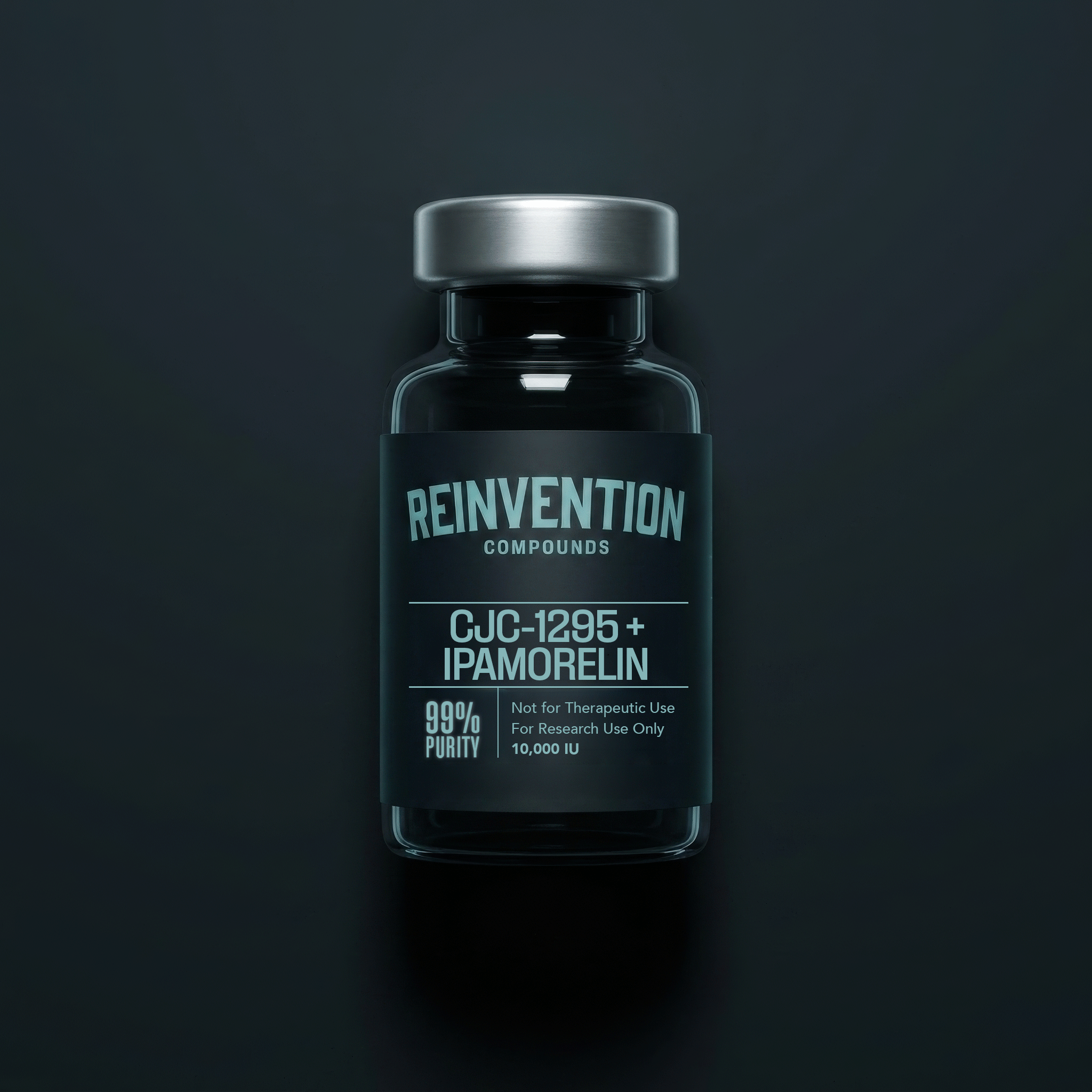
This product is a 1:1 blend of two synergistic peptides: CJC-1295 without DAC (also known as Modified GRF 1-29) and Ipamorelin. The combination pairs two different classes of growth hormone secretagogue that act at opposite ends of the same pathway, which is why they are so commonly studied together.
CJC-1295 (no DAC) is a 29-amino-acid synthetic analog of growth hormone-releasing hormone (GHRH), built from the native GHRH(1-29) sequence with four amino acid substitutions that increase its resistance to enzymatic degradation. Unlike the DAC (Drug Affinity Complex) version, the no-DAC form does not bind albumin and therefore produces a shorter, more physiologic, pulse-like elevation of growth hormone (GH) rather than a prolonged plateau. It binds GHRH receptors on the anterior pituitary, activating cAMP/PKA signaling that drives GH synthesis and secretion.
Ipamorelin is a synthetic pentapeptide (Aib-His-D-2-Nal-D-Phe-Lys-NH2) classified as a growth hormone secretagogue and selective ghrelin-receptor (GHS-R1a) agonist. It stimulates GH release by mimicking ghrelin and lowering somatostatin’s inhibitory tone. Ipamorelin is widely regarded as one of the cleanest peptides in its class because, in research, it releases GH without significant elevation of cortisol or prolactin even at high doses.
Together, the blend operates as a “two-key” system: CJC-1295 increases GH production (the GHRH side), while Ipamorelin enables GH release (the GHRP side). Co-activation of both receptor pathways has been studied for producing a greater, more physiologic GH pulse than either compound alone, with downstream elevation of insulin-like growth factor-1 (IGF-1). This blend has been extensively studied as a research tool in models of GH/IGF-1 axis modulation, body composition, and recovery.
Peptide Information
| CJC-1295 (No DAC) | |
| Peptide Sequence | Tyr-D-Ala-Asp-Ala-Ile-Phe-Thr-Gln-Ser-Tyr-Arg-Lys-Val-Leu-Ala-Gln-Leu-Ser-Ala-Arg-Lys-Leu-Leu-Gln-Asp-Ile-Leu-Ser-Arg-NH2 (Modified GRF 1-29) |
| Molecular Formula | C152H252N44O42 |
| Molecular Weight | 3367.9 g/mol |
| CAS Number | 446036-97-1 |
| Synonyms | Modified GRF (1-29), Mod GRF 1-29, CJC-1295 without DAC, GHRH (1-29)-NH2 |
| Ipamorelin | |
| Peptide Sequence | Aib-His-D-2-Nal-D-Phe-Lys-NH2 |
| Molecular Formula | C38H49N9O5 |
| Molecular Weight | 711.85 g/mol |
| CAS Number | 170851-70-4 |
| Synonyms | NNC 26-0161, Ipamorelin acetate |
| Blend | |
| Ratio | 1:1 by weight |
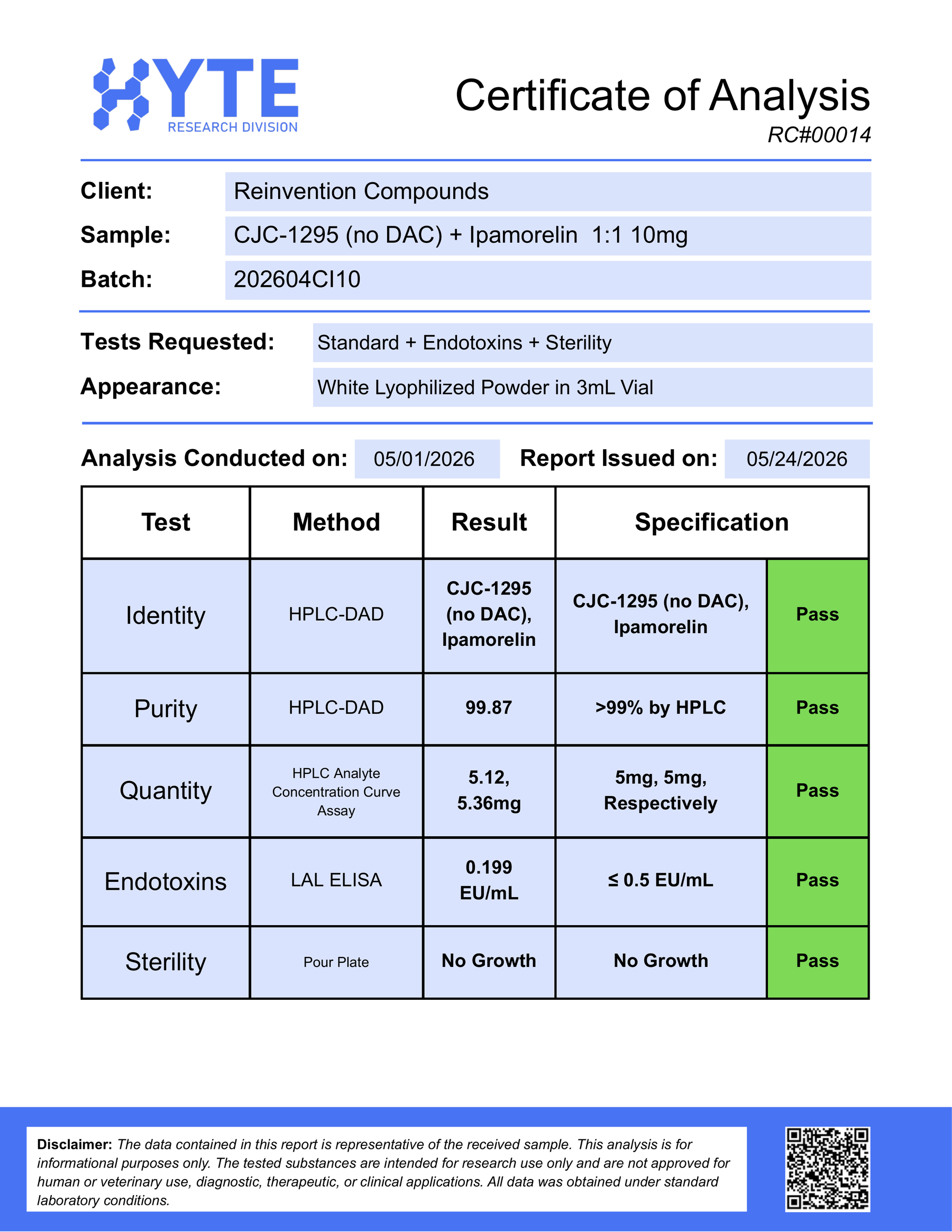
| Total Content | 10mg (5mg CJC-1295 no DAC / 5mg Ipamorelin) |
| Supplied As | Acetate salt |
Lyophilized Peptides:
These peptides are freeze-dried, a process that not only extends shelf life but also preserves the purity and integrity of the peptides during storage. We do not use any fillers in this process. Store refrigerated and protected from light.
Sealed Vial: 10mg of Lyophilized Powder in 3ml Vial (5mg CJC-1295 no DAC / 5mg Ipamorelin, 1:1)
CAS No.: 446036-97-1 (CJC-1295 no DAC); 170851-70-4 (Ipamorelin)
Other Names: Modified GRF 1-29 + Ipamorelin, CJC/Ipa Blend (Acetate)
This Product is Not For Human Consumption and is for Laboratory Use Only. Please Read our Terms and Conditions.
Disclaimer: For Research Purposes Only
This content is provided strictly for research purposes and does not constitute an endorsement or recommendation for the non-laboratory application or improper handling of peptides designed for research. The information, including discussions about specific peptides and their researched benefits, is presented for informational purposes only and must not be construed as health, clinical, or legal guidance, nor an encouragement for non-research use. Peptides described here are solely for use in structured scientific study by authorized individuals. We advise consulting with research experts, medical practitioners, or legal counsel prior to any decisions about obtaining or utilizing these peptides. The expectation of responsible, ethical utilization of this information for legitimate investigative and scholarly objectives is paramount. This notice is dynamic and governs all provided content on research peptides.
CJC-1295 (No DAC) + Ipamorelin Research
The following sections explore the mechanisms and research applications of the CJC-1295 (no DAC) and Ipamorelin blend. Because each peptide has its own distinct research base, the literature is best understood by examining each compound individually and then the rationale for combining them.
CJC-1295 (No DAC): GHRH Receptor Mechanism
CJC-1295 is a stabilized GHRH analog that binds GHRH receptors on pituitary somatotroph cells, activating cAMP/PKA signaling to drive GH synthesis and pulsatile secretion. A randomized, placebo-controlled, double-blind ascending-dose study in healthy adults reported that CJC-1295 produced sustained, dose-dependent increases in GH and IGF-1, with evidence of a cumulative effect across repeated dosing, and was generally well tolerated1. The no-DAC form is specifically studied for preserving a shorter, more physiologic GH pulse pattern rather than the prolonged elevation associated with the albumin-binding DAC variant.
Ipamorelin: Selective GH Secretagogue Mechanism
Ipamorelin was characterized in the foundational research that described it as “the first selective growth hormone secretagogue.” That work demonstrated that ipamorelin releases GH from pituitary cells with potency and efficacy comparable to older GHRPs, but—critically—did not significantly raise ACTH or cortisol even at doses more than 200-fold above the GH-releasing threshold, distinguishing it from GHRP-6 and GHRP-22. This selectivity is the defining feature of ipamorelin in the research literature and the reason it is frequently chosen as the GHRP component in blends.
Synergistic Rationale for the Combination
The mechanistic basis for pairing a GHRH analog with a GHRP is well established: the two act through separate receptors and complementary intracellular pathways. CJC-1295 increases somatotroph GH-producing capacity via the GHRH/cAMP pathway, while Ipamorelin triggers release via the ghrelin-receptor/PLC pathway and reduces somatostatin tone. Reviews of growth hormone secretagogues describe co-administration of GHRH and GHS-receptor agonists as producing a greater, more physiologic GH response than either class alone, with the combination widely studied as a research model for amplified, pulse-preserving GH/IGF-1 elevation3.
Research Considerations
The research literature notes that long-term human data on these compounds is limited and that the principal theoretical consideration with sustained GH/IGF-1 elevation is the proliferative nature of IGF-1 signaling—making IGF-1 and glucose monitoring, along with cycling strategies, standard features of research study designs. In characterized research, the most commonly reported effects are mild and transient: injection-site reactions, flushing, water retention, and headache. Ipamorelin’s lack of significant cortisol/prolactin elevation is consistently highlighted as a favorable component of the blend’s profile2. These considerations are routinely accounted for within controlled study protocols.
References
- Teichman, S. L., Neale, A., Lawrence, B., Gagnon, C., Castaigne, J.-P., & Frohman, L. A. (2006). Prolonged stimulation of growth hormone (GH) and insulin-like growth factor I secretion by CJC-1295, a long-acting analog of GH-releasing hormone, in healthy adults. Journal of Clinical Endocrinology & Metabolism, 91(3), 799–805. https://doi.org/10.1210/jc.2005-1536
- Raun, K., Hansen, B. S., Johansen, N. L., Thøgersen, H., Madsen, K., Ankersen, M., & Andersen, P. H. (1998). Ipamorelin, the first selective growth hormone secretagogue. European Journal of Endocrinology, 139(5), 552–561. https://doi.org/10.1530/eje.0.1390552
- Sigalos, J. T., & Pastuszak, A. W. (2018). The safety and efficacy of growth hormone secretagogues. Sexual Medicine Reviews, 6(1), 45–53. https://doi.org/10.1016/j.sxmr.2017.02.004