
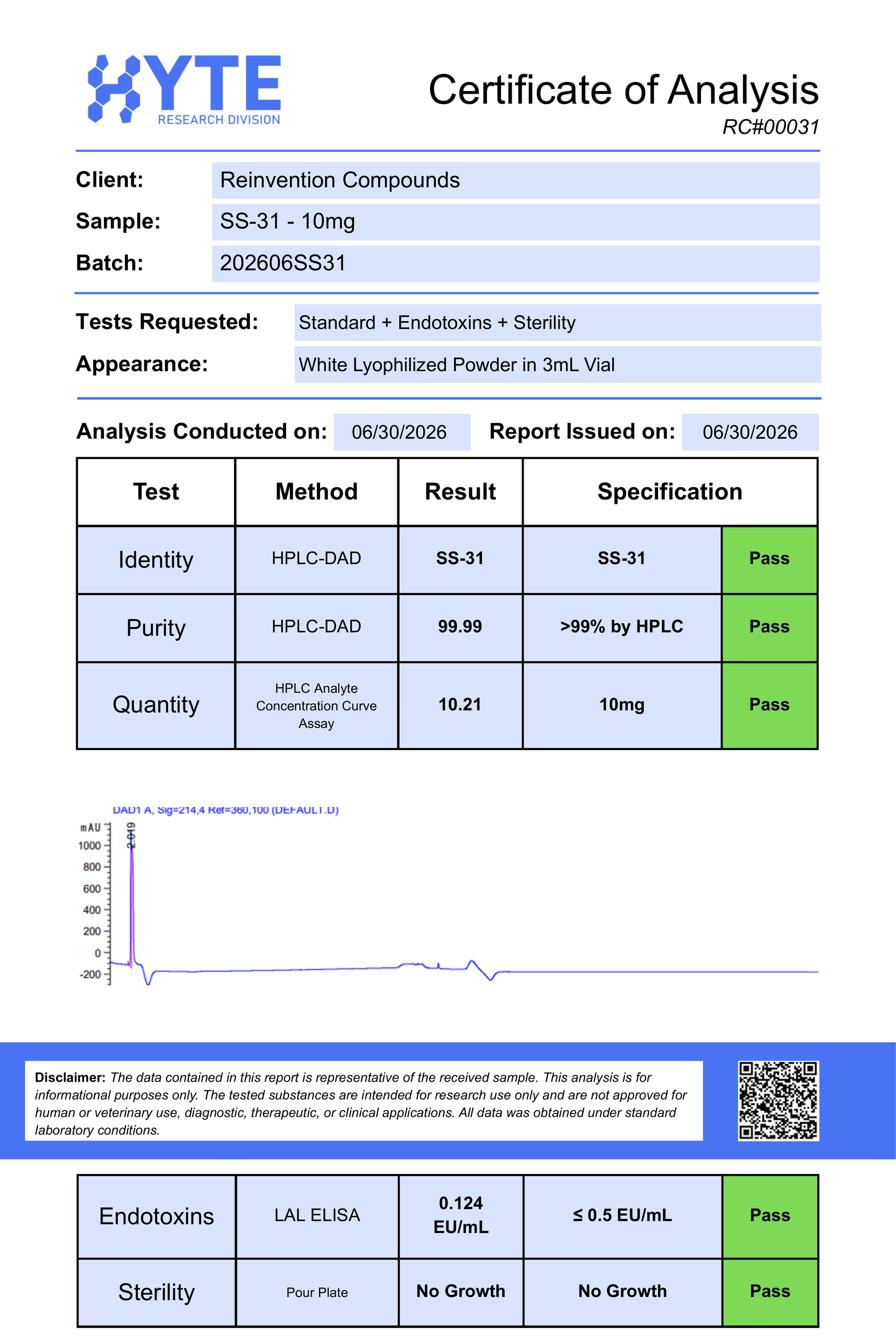







SS-31 10mg Description
SS-31 (Elamipretide) is a synthetic, water-soluble, cell-penetrating tetrapeptide designed to target the inner mitochondrial membrane. It belongs to a class known as Szeto-Schiller (SS) peptides — named for Hazel Szeto and Peter Schiller, who developed the compound at Weill Cornell Medical College in the early 2000s. Its four-amino-acid sequence (D-Arg-Dmt-Lys-Phe-NH₂) incorporates non-standard residues, including D-arginine and 2′,6′-dimethyltyrosine, which give it resistance to enzymatic degradation and an aromatic-cationic structure that allows it to cross cell and mitochondrial membranes and concentrate selectively within mitochondria.
The defining feature of SS-31 is its selective binding to cardiolipin, a phospholipid found almost exclusively on the inner mitochondrial membrane. Cardiolipin is essential for maintaining cristae structure and for the proper organization of the electron transport chain. By stabilizing cardiolipin, SS-31 preserves mitochondrial architecture, supports efficient electron flow, reduces electron leakage and reactive oxygen species (ROS) production, and helps maintain ATP synthesis in energy-demanding tissues.
Due to this targeted mechanism, SS-31 has become one of the most well-characterized mitochondria-targeting peptides in research. It has been extensively studied in models of mitochondrial dysfunction, oxidative stress, and bioenergetic decline across cardiac, renal, neurological, and skeletal muscle tissue. Notably, under its clinical development name elamipretide, the compound advanced through human clinical trials and, in September 2025, received FDA accelerated approval (as Forzinity, Stealth BioTherapeutics) for Barth syndrome — making it the first FDA-approved mitochondria-targeted therapeutic.
Peptide Information
| Property | Value |
|---|---|
| Peptide Sequence | D-Arg-Dmt-Lys-Phe-NH₂ (H-D-Arg-2′,6′-dimethylTyr-Lys-Phe-NH₂) |
| Molecular Formula | C32H49N9O5 |
| Molecular Weight | 639.8 g/mol |
| CAS Number | 736992-21-5 |
| PubChem CID | 11764719 |
| Synonyms | Elamipretide, MTP-131, Bendavia, SS-31, Szeto-Schiller peptide |
Lyophilized Peptides:
These peptides are freeze-dried, a process that not only extends shelf life but also preserves the purity and integrity of the peptides during storage. We do not use any fillers in this process. SS-31 is light-sensitive; store desiccated and protected from light.
Sealed Vial: 10mg of Lyophilized Powder in 3ml Vial
CAS No.: 736992-21-5
Other Names: Elamipretide, MTP-131, Bendavia
This Product is Not For Human Consumption and is for Laboratory Use Only. Please Read our Terms and Conditions.
Disclaimer: For Research Purposes Only This content is provided strictly for research purposes and does not constitute an endorsement or recommendation for the non-laboratory application or improper handling of peptides designed for research. The information, including discussions about specific peptides and their researched benefits, is presented for informational purposes only and must not be construed as health, clinical, or legal guidance, nor an encouragement for non-research use. Peptides described here are solely for use in structured scientific study by authorized individuals. We advise consulting with research experts, medical practitioners, or legal counsel prior to any decisions about obtaining or utilizing these peptides. The expectation of responsible, ethical utilization of this information for legitimate investigative and scholarly objectives is paramount. This notice is dynamic and governs all provided content on research peptides.
SS-31 Research
The following sections explore the diverse applications and mechanisms of SS-31 (Elamipretide) across multiple research domains. As a first-in-class mitochondria-targeting aromatic-cationic peptide, SS-31 has one of the deepest research bodies of any compound in its class, spanning preclinical models through human clinical trials.
Current scientific investigations have focused on its cardiolipin-stabilizing mechanism and its effects on mitochondrial bioenergetics, oxidative stress, and tissue protection. This overview synthesizes key findings on its mechanism and experimental applications in cardiac, renal, neurological, and mitochondrial-myopathy contexts.
Cardiolipin Binding and Mitochondrial Mechanism
SS-31’s mechanism centers on its selective association with cardiolipin, an anionic phospholipid expressed almost exclusively on the inner mitochondrial membrane and required for cristae formation and the organization of respiratory complexes. Foundational research using a polarity-sensitive fluorescent analog of SS-31 demonstrated that the peptide binds with high affinity to cardiolipin and that the SS-31/cardiolipin complex inhibits cytochrome c peroxidase activity, protecting against the cardiolipin peroxidation that drives mitochondrial damage during ischemia1.
By preserving cardiolipin integrity, SS-31 maintains the structural organization of the electron transport chain, reduces electron leak, and improves coupling between electron transport and oxidative phosphorylation — attenuating mitochondrial reactive oxygen species indirectly rather than acting as a conventional free-radical scavenger2. This positioned cardiolipin as a pharmacological target and SS-31 as a first-in-class cardiolipin-protective compound for restoring mitochondrial bioenergetics2.
Renal and Ischemia-Reperfusion Research
SS-31’s effects on renal mitochondria have been extensively investigated. Research demonstrated that SS-31 accelerates ATP recovery after ischemia and reduces acute kidney injury by preserving the mitochondrial cristae membranes required for ATP synthesis1. This work established the model for SS-31’s protective role in ischemia-reperfusion contexts and informed subsequent investigation across other energy-demanding tissues.
Mitochondrial Myopathy Research
Primary mitochondrial myopathy (PMM) has been a major clinical research focus through the MMPOWER program. An early randomized dose-escalation trial provided Class I evidence that elamipretide improved distance walked on the 6-minute walk test in PMM participants3, and the randomized crossover MMPOWER-2 trial generated an efficacy signal supporting advancement to Phase 34.
The pivotal Phase 3 MMPOWER-3 trial — a 24-week, randomized, double-blind, placebo-controlled study of 218 adults with genetically confirmed PMM — did not meet its primary endpoints, with no statistically significant difference between elamipretide and placebo on the 6-minute walk test or total fatigue score5. Notably, a pre-specified consideration and post-hoc analysis identified that participants with nuclear DNA defects performed significantly better on the 6-minute walk test, whereas those with mitochondrial DNA mutations did not — underscoring the importance of genotype in evaluating mitochondrial-targeted compounds5,6.
Barth Syndrome and Regulatory Status
The most advanced research application is Barth syndrome, a genetic disorder caused by TAFAZZIN mutations that result in abnormal cardiolipin. Following the TAZPOWER clinical program, elamipretide received FDA accelerated approval in September 2025 (marketed as Forzinity, Stealth BioTherapeutics) to improve muscle strength in adult and pediatric Barth syndrome patients weighing at least 30 kg — making it the first FDA-approved mitochondria-targeted therapeutic7.
Research Considerations
Across the clinical research literature, SS-31/elamipretide has been characterized as having a generally favorable tolerability profile, with mild injection-site reactions and headache among the most commonly reported effects; hypersensitivity reactions have also been observed in clinical settings5,7. These considerations are routinely accounted for within controlled study protocols.
References
- Birk, A. V., Liu, S., Soong, Y., Mills, W., Singh, P., Warren, J. D., Seshan, S. V., Pardee, J. D., & Szeto, H. H. (2013). The mitochondrial-targeted compound SS-31 re-energizes ischemic mitochondria by interacting with cardiolipin. Journal of the American Society of Nephrology, 24(8), 1250–1261. https://doi.org/10.1681/ASN.2012121216
- Szeto, H. H. (2014). First-in-class cardiolipin-protective compound as a therapeutic agent to restore mitochondrial bioenergetics. British Journal of Pharmacology, 171(8), 2029–2050. https://doi.org/10.1111/bph.12461
- Karaa, A., Haas, R., Goldstein, A., Vockley, J., Weaver, W. D., & Cohen, B. H. (2018). Randomized dose-escalation trial of elamipretide in adults with primary mitochondrial myopathy. Neurology, 90(14), e1212–e1221. https://doi.org/10.1212/WNL.0000000000005255
- Karaa, A., Haas, R., Goldstein, A., Vockley, J., & Cohen, B. H. (2020). A randomized crossover trial of elamipretide in adults with primary mitochondrial myopathy. Journal of Cachexia, Sarcopenia and Muscle, 11(4), 909–918. https://doi.org/10.1002/jcsm.12559
- Karaa, A., Bertini, E., Carelli, V., Cohen, B. H., Enns, G. M., Falk, M. J., et al. (2023). Efficacy and safety of elamipretide in individuals with primary mitochondrial myopathy: The MMPOWER-3 randomized clinical trial. Neurology, 101(3), e238–e252. https://doi.org/10.1212/WNL.0000000000207402
- Karaa, A., Bertini, E., Carelli, V., Cohen, B., Enns, G. M., Falk, M. J., et al. (2024). Genotype-specific effects of elamipretide in patients with primary mitochondrial myopathy: a post hoc analysis of the MMPOWER-3 trial. Orphanet Journal of Rare Diseases, 19(1), 431. https://doi.org/10.1186/s13023-024-03421-5
- U.S. Food and Drug Administration. (2025). FORZINITY (elamipretide) injection — Center for Drug Evaluation and Research approval package (NDA 215244). https://www.accessdata.fda.gov/drugsatfda_docs/nda/2025/215244Orig1s000Approv.pdf