
GHK-Cu Description
GHK-Cu is a naturally occurring copper-binding tripeptide complex, formed by the peptide glycyl-L-histidyl-L-lysine (GHK) bound to a copper(II) ion. It was first isolated from human plasma in 1973 by Loren Pickart, identified as the factor that caused aged human liver tissue to synthesize proteins like younger tissue. GHK binds copper with exceptionally high affinity, forming a stable square-planar complex (GHK-Cu) that is the biologically active form responsible for the peptide’s regenerative effects.
GHK-Cu functions primarily as a copper-delivery system and a broad regulator of tissue remodeling. The bound copper activates lysyl oxidase (essential for collagen and elastin cross-linking), while the complex modulates matrix metalloproteinases and their inhibitors to preserve extracellular matrix integrity. Beyond enzyme regulation, GHK-Cu acts as a potent epigenetic modulator, influencing the expression of a large fraction of human genes — upregulating pathways involved in antioxidant defense, DNA repair, and tissue remodeling while downregulating inflammatory and pro-fibrotic signaling.
Plasma levels of GHK decline markedly with age (from roughly 200 ng/mL at age 20 to around 80 ng/mL by age 60), a decline that correlates with reduced tissue regeneration capacity. GHK-Cu has been extensively studied as a research compound in models of wound healing, skin and connective-tissue remodeling, angiogenesis, hair-follicle biology, and gene-expression modulation. It is studied here strictly as a research peptide.
Peptide Information
| Peptide Sequence | Glycyl-L-histidyl-L-lysine : Cu(II) (Gly-His-Lys · Cu²⁺) |
| Molecular Formula (GHK-Cu complex) | C14H24N6O4·Cu |
| Molecular Weight (GHK-Cu complex) | ~340.9 g/mol |
| GHK Peptide Molecular Formula | C14H24N6O4 (free tripeptide) |
| GHK Peptide Molecular Weight | 340.4 g/mol (free tripeptide) |
| CAS Number | 49557-75-7 |
| Synonyms | Copper Tripeptide-1, Cu-GHK, GHK-Copper, Glycyl-L-histidyl-L-lysine copper |
Lyophilized Peptides:
These peptides are freeze-dried, a process that not only extends shelf life but also preserves the purity and integrity of the peptides during storage. We do not use any fillers in this process. GHK-Cu should be stored refrigerated and protected from light; protect reconstituted solution from light.
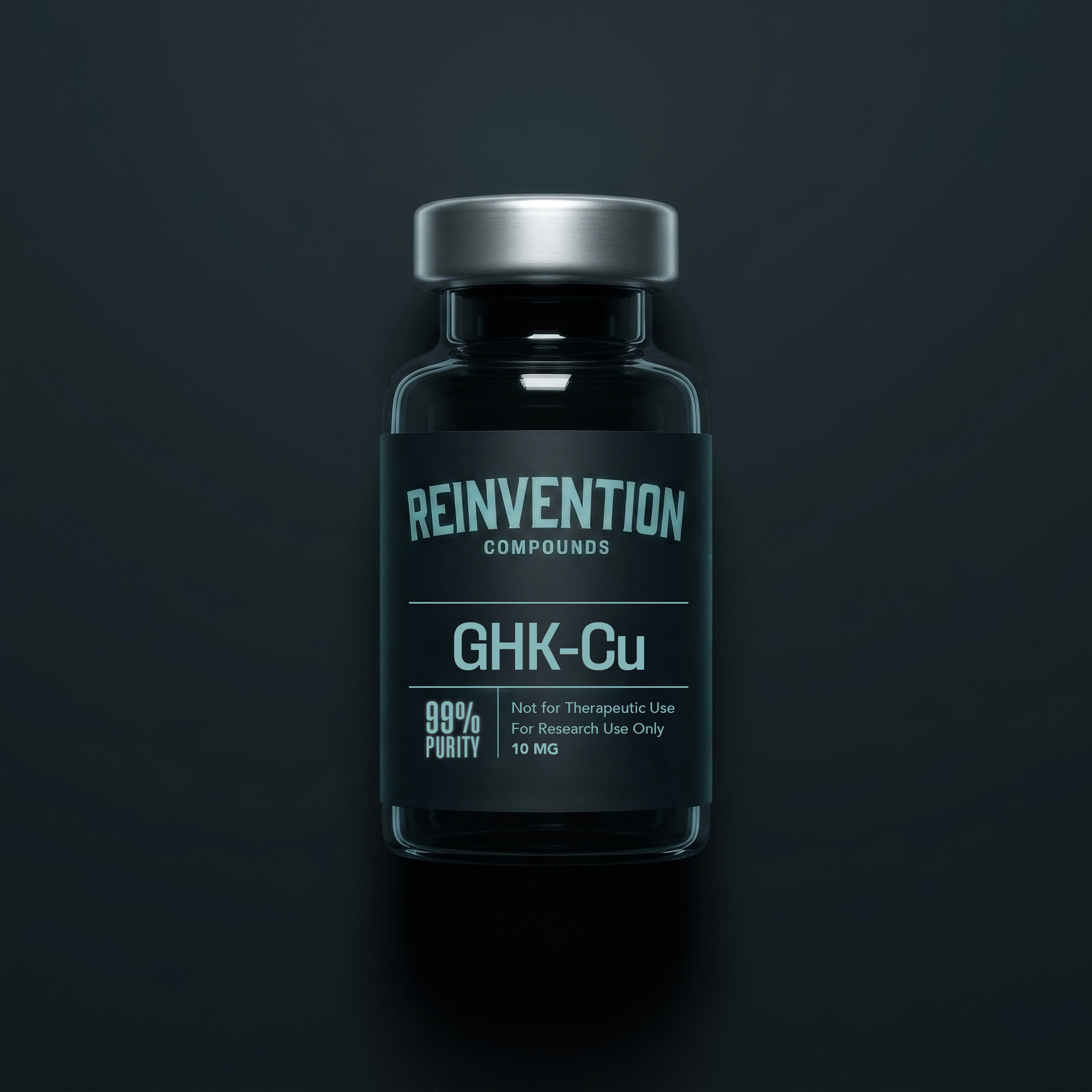
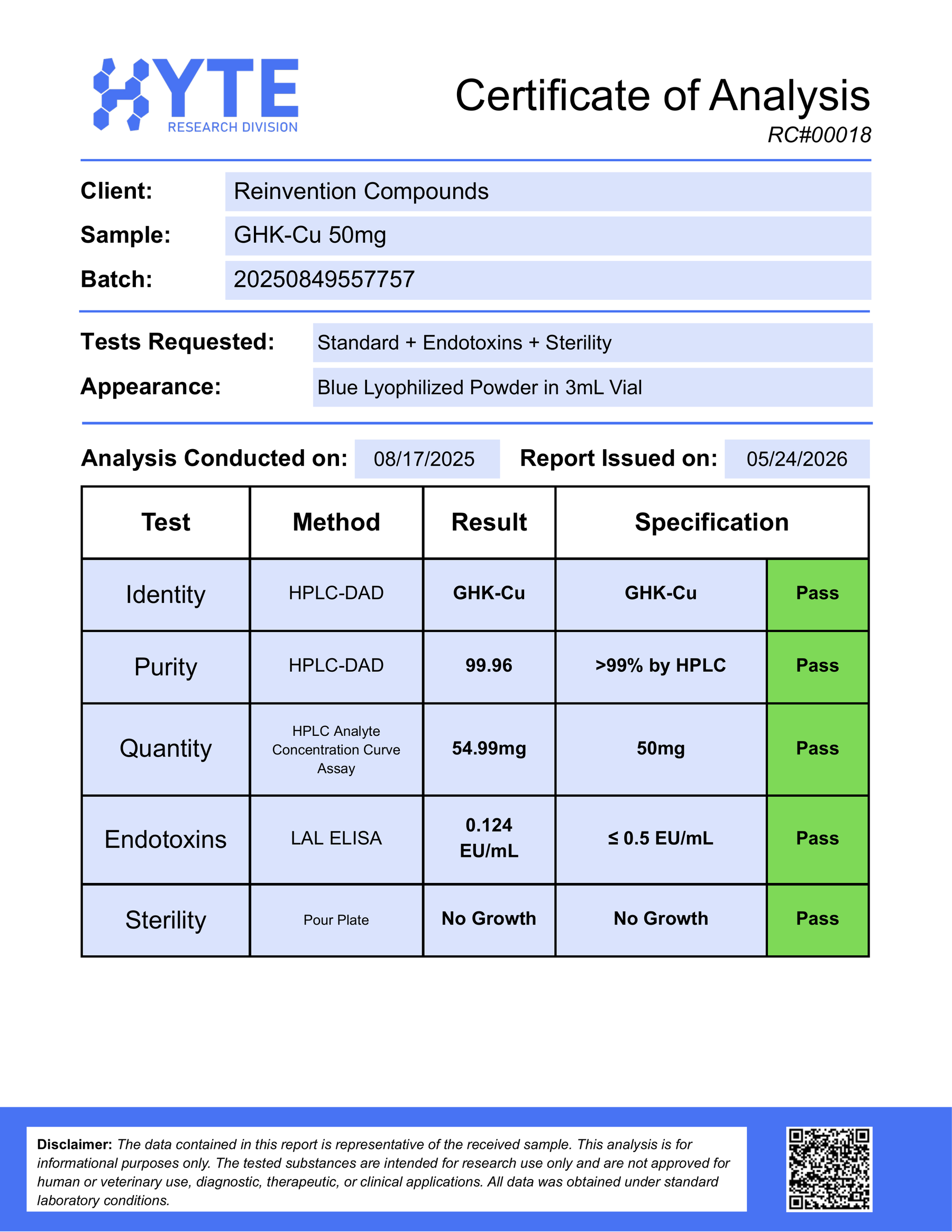
Sealed Vial: 50mg of Lyophilized Powder in 3ml Vial
CAS No.: 49557-75-7
Other Names: Copper Tripeptide-1, Cu-GHK, GHK-Copper
This Product is Not For Human Consumption and is for Laboratory Use Only. Please Read our Terms and Conditions.
Disclaimer: For Research Purposes Only
This content is provided strictly for research purposes and does not constitute an endorsement or recommendation for the non-laboratory application or improper handling of peptides designed for research. The information, including discussions about specific peptides and their researched benefits, is presented for informational purposes only and must not be construed as health, clinical, or legal guidance, nor an encouragement for non-research use. Peptides described here are solely for use in structured scientific study by authorized individuals. We advise consulting with research experts, medical practitioners, or legal counsel prior to any decisions about obtaining or utilizing these peptides. The expectation of responsible, ethical utilization of this information for legitimate investigative and scholarly objectives is paramount. This notice is dynamic and governs all provided content on research peptides.
GHK-Cu Research
The following sections explore the diverse applications and mechanisms of GHK-Cu across multiple research domains. As one of the most studied copper-peptide complexes, it has an extensive literature spanning tissue repair, gene-expression modulation, skin and connective-tissue biology, and angiogenesis.
This overview synthesizes key findings on its copper-delivery and enzyme mechanisms and its experimental applications in gene modulation, skin remodeling, wound healing, and antioxidant/anti-inflammatory signaling.
Copper Delivery and Enzyme Activation
GHK-Cu’s defining mechanism is its function as a high-affinity copper carrier. The complex delivers Cu(II) in a controlled, bioavailable form, supporting copper-dependent enzymes including lysyl oxidase — required for collagen and elastin cross-linking — while modulating matrix metalloproteinases and their tissue inhibitors to maintain extracellular matrix integrity1. This positions GHK-Cu as a regulator of structural-tissue remodeling rather than a simple growth signal.
Gene-Expression Modulation
A major research focus is GHK’s broad transcriptomic influence. Gene-profiling work reported that GHK modulates the expression of a substantial fraction of human genes — upregulating antioxidant, DNA-repair, and tissue-remodeling pathways while downregulating inflammatory and pro-fibrotic genes — producing transcriptional profiles characteristic of less-aged cells in vitro1. This epigenetic-modulator framing is central to the modern understanding of the peptide.
Skin and Connective-Tissue Remodeling
GHK-Cu has been extensively studied for its effects on skin biology. Reviews of its cellular pathways describe stimulation of collagen, elastin, and glycosaminoglycan synthesis, support of dermal fibroblast function, and improvement of skin-remodeling endpoints in experimental models — mechanisms underlying its long-standing use as a research tool in dermal regeneration2.
Wound Healing and Angiogenesis
The wound-healing literature is the oldest and most established for this peptide. Research reviews document GHK-Cu’s stimulation of blood-vessel and nerve outgrowth, attraction of immune cells, and acceleration of tissue repair across skin, lung connective tissue, bone, liver, and stomach-lining models — consistent with its identification as an endogenous repair-signaling molecule1,2.
Antioxidant and Anti-Inflammatory Signaling
GHK-Cu has been studied for protective signaling beyond structural repair. The research literature describes suppression of pro-inflammatory pathways and support of antioxidant defense systems, contributing to its characterization as a broadly cytoprotective copper peptide1.
Research Considerations
Because GHK-Cu delivers copper, the research literature notes that copper balance is a relevant variable in study design, and prolonged or high-concentration exposure is typically monitored for copper–zinc balance considerations. In characterized research, reported effects are generally limited to mild, transient injection-site or topical irritation. These considerations are routinely accounted for within controlled study protocols.
References
- Pickart, L., & Margolina, A. (2018). Regenerative and protective actions of the GHK-Cu peptide in the light of the new gene data. International Journal of Molecular Sciences, 19(7), 1987. https://doi.org/10.3390/ijms19071987
- Pickart, L., Vasquez-Soltero, J. M., & Margolina, A. (2015). GHK peptide as a natural modulator of multiple cellular pathways in skin regeneration. BioMed Research International, 2015, 648108. https://doi.org/10.1155/2015/648108