



Methylene Blue Description
Methylene Blue (methylthioninium chloride) is a synthetic phenothiazine compound with the molecular formula C16H18ClN3S, first synthesized in 1876 by German chemist Heinrich Caro as a textile dye. Within a decade it was being investigated as one of the earliest synthetic pharmaceutical compounds — used as an antimalarial agent, later as a redox indicator in analytical chemistry, and eventually characterized for its role as a cellular electron carrier. It carries a USP compendial monograph, meaning its identity, purity, and impurity limits are defined by United States Pharmacopeia standards.
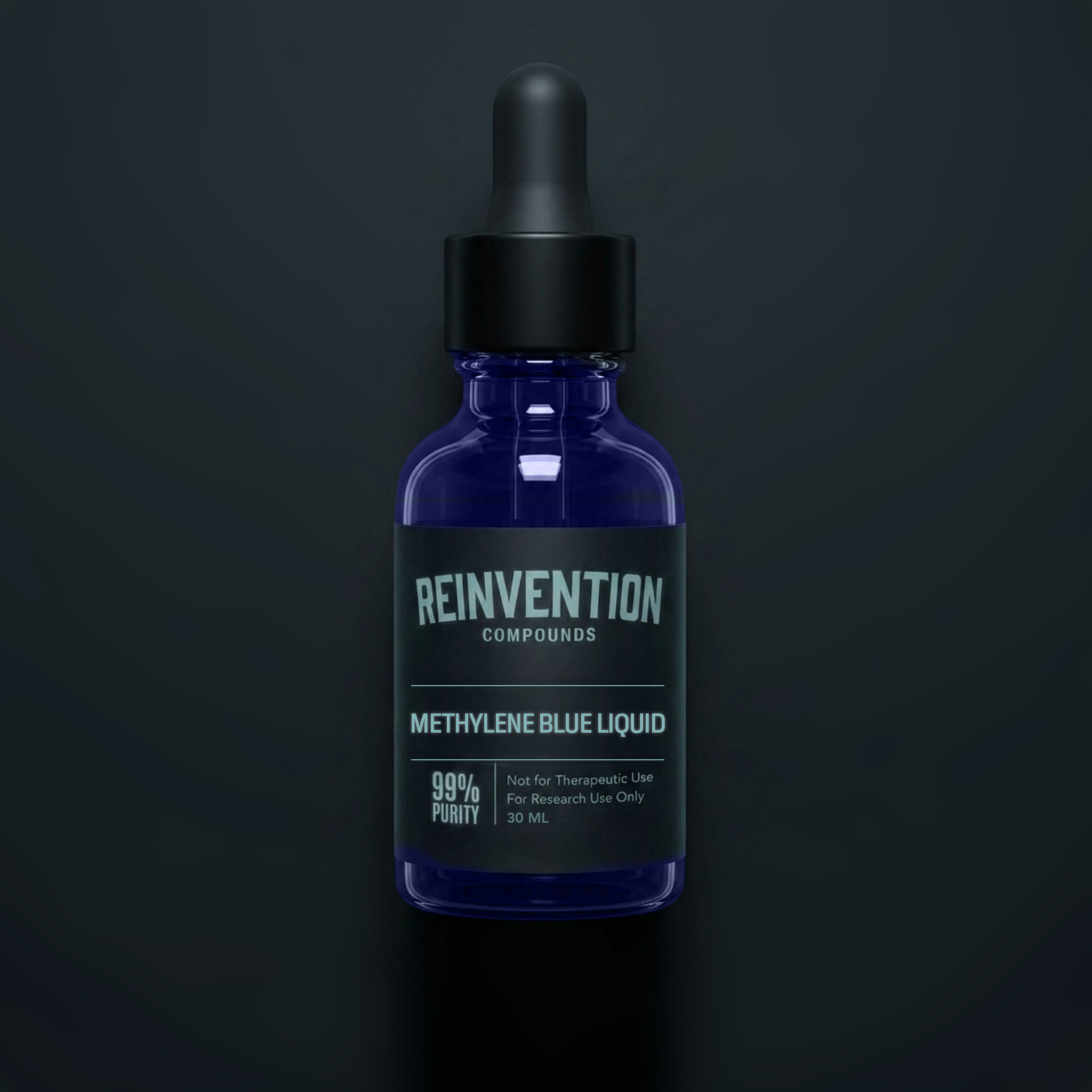
This product is a USP-grade methylene blue solution supplied at 150mg in a 30ml amber glass dropper bottle (5mg/mL), formulated with pharmaceutical-grade purified water and characterized for identity and heavy-metal content. Each 1mL contains approximately 20 drops, delivering roughly 0.25mg of methylene blue per drop. The solution is a deep indigo-blue color characteristic of the oxidized form of the compound.
Methylene Blue is one of the most extensively investigated small molecules in modern biomedical research, with a literature spanning over 18,000 peer-reviewed publications across mitochondrial bioenergetics, neuroscience, redox biology, and clinical pharmacology. It is studied here strictly as a research compound.
Compound Information
Liquid Solution:
This product is supplied as a ready-to-handle aqueous solution at a defined concentration, sparing researchers the reconstitution step and reducing dose-preparation variability. The solution is packaged in a light-restricting amber glass dropper bottle to protect against photodegradation. Methylene blue is oxidation-sensitive and light-sensitive; keep tightly closed and away from direct light.
Sealed Bottle: 150mg of USP Methylene Blue in 30ml Aqueous Solution (5mg/mL)
Approximate Delivery: ~0.25mg per drop (based on 20 drops/mL)
CAS No.: 61-73-4
Other Names: Methylthioninium chloride, USP Methylene Blue, Basic Blue 9
Storage: Store at room temperature in a cool, dry place away from direct light. Refrigeration is not required. Do not use if the solution has precipitated or lost its characteristic deep blue color.
Handling Note: Methylene blue is a powerful staining agent. It will permanently stain fabric, porous surfaces, and dental composites on direct contact. Handle with care; clean spills immediately with soap and water while the solution is still wet.
This Product is Not For Human Consumption and is for Laboratory Use Only. Please Read our Terms and Conditions.
Disclaimer: For Research Purposes Only
This content is provided strictly for research purposes and does not constitute an endorsement or recommendation for the non-laboratory application or improper handling of this compound. The information, including discussions about methylene blue and its researched properties, is presented for informational purposes only and must not be construed as health, clinical, or legal guidance, nor an encouragement for non-research use. This compound is solely for use in structured scientific study by authorized individuals. We advise consulting with research experts, medical practitioners, or legal counsel prior to any decisions about obtaining or utilizing this compound. The expectation of responsible, ethical utilization of this information for legitimate investigative and scholarly objectives is paramount. This notice is dynamic and governs all provided content on research compounds.
Methylene Blue Research
The following sections explore the diverse applications and mechanisms of methylene blue across multiple research domains. As one of the earliest synthetic pharmaceutical compounds and one of the most-studied small molecules in modern biology, it has an exceptionally deep literature spanning mitochondrial bioenergetics, neuroscience, and redox chemistry.
This overview synthesizes key findings on its cellular electron-carrier mechanism and experimental applications in mitochondrial function, cognitive research, and neuroprotection.
Mitochondrial Electron-Carrier Mechanism
Methylene blue’s defining biochemical property is its ability to function as an alternative electron carrier in the mitochondrial electron transport chain. Research characterized how the compound cycles between its oxidized (MB) and reduced (leukomethylene blue) forms, accepting electrons from NADH and donating them directly to cytochrome c — effectively bypassing complex I/III dysfunction and enhancing oxygen consumption and ATP production. This “electron shuttle” mechanism forms the biochemical foundation for the compound’s broad research profile in bioenergetics1.
Cognitive and Neuroscience Research
A large body of preclinical and early-clinical research has characterized methylene blue’s effects on brain metabolism and cognitive endpoints. Research demonstrated that low-dose methylene blue administration enhanced memory retention and increased cytochrome c oxidase activity in the brain in animal models — establishing its hormetic dose-response profile in which low doses enhance mitochondrial function while high doses have opposing effects2. A comprehensive review synthesizes the neuroprotective and cognitive-enhancement research across models of memory, hypoxia, and neurodegeneration3.
Human Neuroimaging Research
Translational human research has extended these findings. A functional MRI study in healthy adults reported that a single low oral dose of methylene blue increased response in bilateral insular cortex during a psychomotor vigilance task and improved short-term memory retrieval performance — providing human-subject evidence of the compound’s central-nervous-system activity at low doses4.
Redox and Antioxidant Research
Beyond its role as an electron carrier, methylene blue has been characterized as a redox modulator with hormetic biphasic activity: at low concentrations it supports cellular antioxidant defense and mitochondrial function; at high concentrations it exhibits pro-oxidant behavior. Research explores this dose-dependent switch as a defining feature of the compound’s pharmacology and a critical variable in study design1,3.
Research Considerations
The research literature identifies several important considerations for study design with methylene blue:
- Hormetic dose-response. Effects reverse above roughly 1–2 mg/kg in animal models. Study designs routinely distinguish low-dose from high-dose protocols.
- Serotonergic drug interactions. Methylene blue is a potent monoamine oxidase inhibitor (MAO-A) and must not be combined with SSRIs, SNRIs, MAOIs, tricyclic antidepressants, or other serotonergic agents. Concurrent exposure can produce serotonin syndrome, a potentially fatal reaction.
- G6PD deficiency. Individuals with glucose-6-phosphate dehydrogenase deficiency can experience hemolytic anemia. Contraindicated in G6PD-deficient study populations.
- Pregnancy and lactation. Contraindicated during pregnancy (fetal risk documented) and lactation.
- Reversible staining. Blue coloration of urine and mucosal surfaces is expected and transient during and shortly after exposure.
These considerations are routinely accounted for within controlled study protocols.
References
- Tucker, D., Lu, Y., & Zhang, Q. (2018). From mitochondrial function to neuroprotection — an emerging role for methylene blue. Molecular Neurobiology, 55(6), 5137–5153. https://doi.org/10.1007/s12035-017-0712-2
- Callaway, N. L., Riha, P. D., Bruchey, A. K., Munshi, Z., & Gonzalez-Lima, F. (2004). Methylene blue improves brain oxidative metabolism and memory retention in rats. Pharmacology Biochemistry and Behavior, 77(1), 175–181. https://doi.org/10.1016/j.pbb.2003.10.007
- Rojas, J. C., Bruchey, A. K., & Gonzalez-Lima, F. (2012). Neurometabolic mechanisms for memory enhancement and neuroprotection of methylene blue. Progress in Neurobiology, 96(1), 32–45. https://doi.org/10.1016/j.pneurobio.2011.10.007
- Rodriguez, P., Zhou, W., Barrett, D. W., Altmeyer, W., Gutierrez, J. E., Li, J., et al. (2016). Multimodal randomized functional MR imaging of the effects of methylene blue in the human brain. Radiology, 281(2), 516–526. https://doi.org/10.1148/radiol.2016152893